

2026/03 - Rethinking Rheology for Complex Formulations and Soft Materials
Date: March 11, 2026
For decades, mechanical rheometers have been the standard tool to measure viscoelastic properties. But what happens when materials are fragile, or constantly evolving?
Many modern formulations, including polymer solutions, emulsions, creams, gels, and biological systems, contain complex microstructures that can be altered by the mechanical shear applied during conventional rheological measurements.
At LS Instruments, we approach this challenge with optical microrheology.
The DWS RheoLab, based on Diffusing Wave Spectroscopy (DWS), measures the microscopic motion of particles inside materials using multiple light scattering. This allows researchers to analyze microstructure dynamics and viscoelastic behavior without mechanically perturbing the sample.
Rethinking Rheology for Complex Materials
For decades, mechanical rheometers have been the standard instruments used to measure the viscoelastic properties of materials. While these techniques provide essential information about the macroscopic response of a material under deformation, they can face limitations when analyzing fragile, or dynamically evolving formulations.
Many modern materials, including polymer solutions, emulsions, creams, gels, and biological formulations, possess complex microstructures that may be altered by the shear forces or large deformations applied during conventional rheological measurements.
To complement classical methods, LS Instruments developed the DWS RheoLab, a rheology platform based on Diffusing Wave Spectroscopy (DWS). By probing the microscopic motion of particles using multiple light scattering, DWS provides access to microstructural dynamics and viscoelastic behavior without mechanically perturbing the sample, offering new insights into the stability and evolution of complex materials.
Bringing Advanced Rheology into Industrial Formulation Development
While rheology has traditionally been associated with academic research and material science, the characterization of complex materials is increasingly becoming a critical tool in industrial product development, process optimization and quality control.
Diffusing Wave Spectroscopy (DWS)-based microrheology extends the possibilities of conventional rheological techniques by enabling the characterization of concentrated, turbid and structured materials directly in their native state, often without dilution, extensive sample preparation or mechanical disturbance.
This approach is particularly valuable in industries where product performance is closely linked to microstructure, viscoelastic properties and long-term stability.
Pharmaceutical and Biopharmaceutical Formulations
In pharmaceutical development, rheological characterization plays an important role in understanding the behavior of:
- Injectable formulations
- Protein and antibody formulations
- Hydrogels and drug delivery systems
- Vaccine formulations
- Cell and tissue culture matrices
DWS microrheology can provide insight into gelation processes, structural evolution, formulation stability and batch-to-batch consistency while working with small sample volumes and highly concentrated systems.
Cosmetics and Personal Care Products
The sensory perception and performance of cosmetic products are strongly influenced by their rheological properties.
Typical applications include:
- Creams and lotions
- Emulsions
- Serums and gels
- Hair care products
- Sunscreens and specialty formulations
Advanced rheological analysis supports formulation optimization, texture control, shelf-life studies and stability assessment throughout the product lifecycle.
Food and Beverage Formulations
Food manufacturers increasingly rely on rheological characterization to understand and control texture, mouthfeel and processing behavior.
Applications include:
- Dairy products
- Protein-rich formulations
- Gel-based foods
- Emulsified products
- Plant-based alternatives
- Functional food ingredients
DWS enables the investigation of highly concentrated and opaque products that are often difficult to analyze using traditional optical methods.
Polymers, Specialty Chemicals and Advanced Materials
Many industrial materials exhibit complex viscoelastic behavior that directly impacts processing and end-use performance.
Examples include:
- Polymer solutions and dispersions
- Coatings and paints
- Inks and printing formulations
- Adhesives and sealants
- Microgels and colloidal systems
- Advanced soft materials
Microrheological characterization helps researchers and product developers understand structural dynamics, gel formation, curing processes and long-term stability.
From Material Characterization to Better Products
By providing access to rheological information directly within complex native samples, Diffusing Wave Spectroscopy offers a complementary approach to conventional rheology. Researchers and formulation scientists can gain a deeper understanding of material behavior, accelerate formulation development and support data-driven decisions throughout the innovation process.
Optical Rheology: Measuring Microstructure Dynamics
The DWS RheoLab performs microrheology measurements using light scattering to monitor microscopic motion of particles inside complex fluids.
From these microscopic fluctuations, the instrument derives the viscoelastic properties of the material across a wide frequency range.
Unlike classical rheometers, the measurement is:
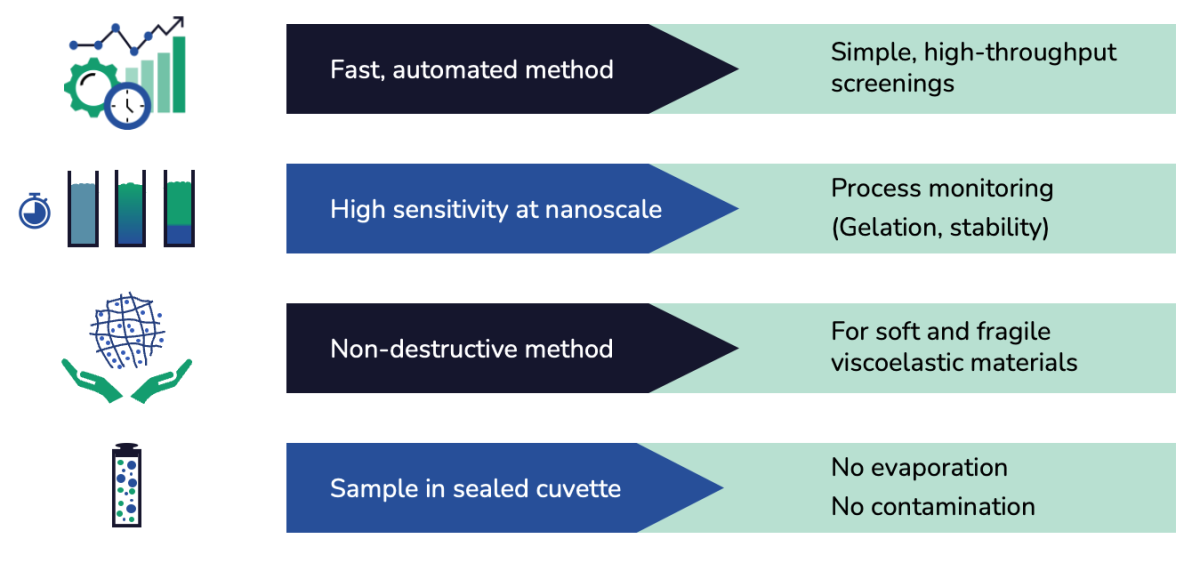
- contact-free
- non-destructive
- extremely sensitive to microstructure changes
This enables researchers to analyze systems that are difficult or impossible to measure using traditional mechanical rheometers.
Benefits and Applications in R&D Laboratories
As a micro-rheology platform, the DWS RheoLab provides several advantages no matter your specific application:
- G′ and G″ across a very wide frequency range
- Sealed cuvette for no evaporation or contamination
- Very small sample volumes (~0.2–2 mL)
- No mechanical shear applied to the sample
- Continuous in-situ measurement over time
- Go back to your sample for shelf-life studies
The benefits are relevant for different sample types and applications:
Emulsions and Creams

Studying stability and structural evolution in food and cosmetic formulations. Read the article.
Extend the rheological characterization of emulsions. Read the application note.
Polymer Solutions

Access viscoelastic spectra over a very wide frequency range in a single measurement. The Cox–Merz rule allows derivation of
flow-curve data normally obtained from mechanical rotational instruments. Read the application note.
Gelation Processes

Detect the gel point as G′ crosses G″ without disturbing the forming network. Resolve sol–gel transitions
as a function of temperature, concentration, or time with high resolution. Read the application note.
Microstructure Stability
Track hydrodynamic radius evolution and detect aggregation, coalescence, and Ostwald ripening in real time.
Enables accelerated stability testing at conditions that cannot be measured mechanically. Read the application note.
Optical Rheology: How it works
The DWS RheoLab performs microrheology measurements using light scattering to monitor microscopic motion of particles inside complex materials.
| Light probes motion | Motion reveals mechanics |
|---|---|
| Laser light scattered many times through a turbid sample carries information about the microscopic motion of tracer particles. DWS decodes these fluctuations to reconstruct particle dynamics at the nanoscale. | From the mean squared displacement of particles, the instrument extracts storage modulus (G′) and loss modulus (G″) over a very wide frequency range without ever applying a shear deformation. |
From these microscopic fluctuations, the instrument derives the viscoelastic properties of the material across a wide frequency range.
Based on a non-destructive, contact-free approach, it is ideally suited for soft, fragile materials undergoing microstructural changes. These are difficult to impossible to measure using traditional mechanical rheometers.
DWS and Mechanical Rheometry: complementary tools
| DWS Microrheology | Mechanical Rheometry | |
|---|---|---|
|
|
Thermal particle motion (passive) | Response to applied deformation |
|
|
Microscopic structural dynamics | Macroscopic mechanical behavior |
Shear |
None applied to sample | Applied (controlled stress or strain) |
Samples |
Fragile, evolving viscoelastic systems | Broad but may alter fragile systems |
Strength |
Unbiased detection of gelation, instability, aggregation | Absolute moduli, large deformation response |