

Particle Size Analysis
Advanced dynamic light scattering (DLS) for the measurement of complex and turbid samples
Dynamic light scattering (DLS) is a widely used method for determining the size of particles in suspension. It is also known as photon correlation spectroscopy or quasi-elastic light scattering and is one of the most popular techniques for the determination of nanoparticles.
Typical applications include particle sizing of emulsions, micelles, polymers, proteins, nanoparticles and other colloidal systems.
DLS particle size analysis
Dynamic Light Scattering (DLS, also known as Photon Correlation Spectroscopy or Quasi-Elastic Light Scattering) is one of the most popular physical characterization methods of nano-scale dispersions because it is quick, easy, non-destructive and has a wide dynamic range of sizing capability from under 1nm to 10 microns, depending on the sample. Typical applications include particle sizing of emulsions, micelles, polymers, proteins, nanoparticles or colloids.
Contact-free
Fast
Easy-to-use
Support
Error-free DLS
What if your particle size has been wrong all along?
A measurement error you can't detect
In concentrated formulations, photons scatter off multiple particles before reaching the detector. The
measurement looks normal — but the reported size can be dramatically wrong.
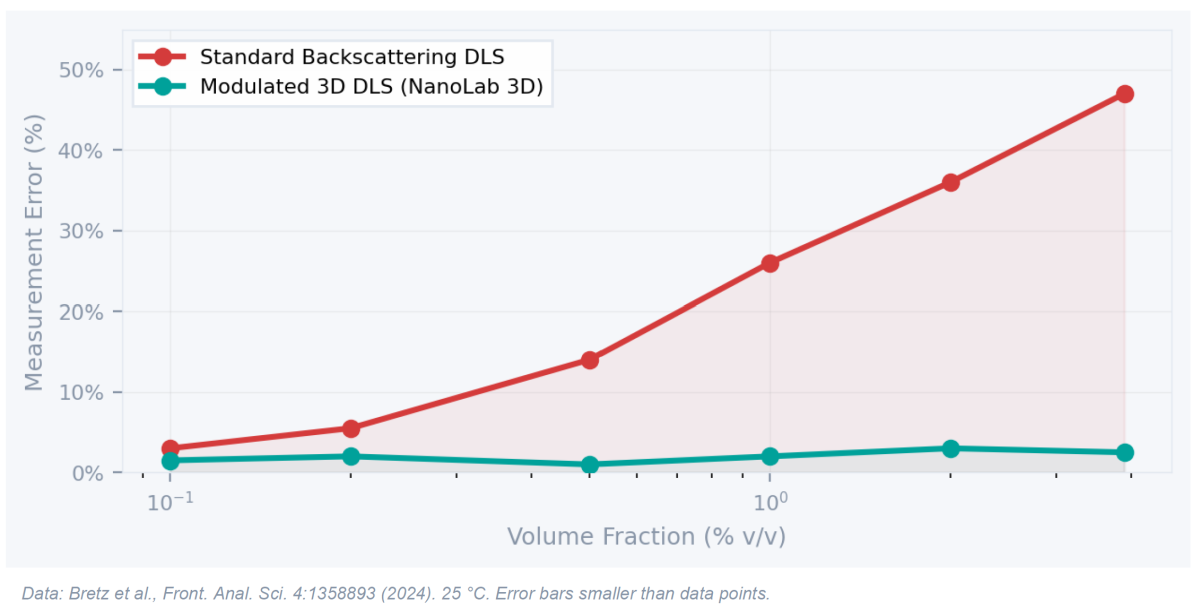
Standard backscattering DLS at 173° reduces multiple scattering but cannot eliminate it. The onset is unpredictable, and erroneous results still appear reliable — good signal-to-noise, no warning flags. You trust the wrong number without ever knowing it.
No alarm, no trace
Multiple scattering systematically reduces the apparent particle size. No quality metric will alert you. The data looks clean, the result looks plausible — and it's wrong.
Dilution creates new problems
Diluting the sample to suppress multiple scattering introduces its own uncertainties. For aluminum adjuvants, dilution has been shown to alter the actual particle size.
See it in the data
Measurements on AddaVax™, a commercial squalene-based vaccine adjuvant (~146 nm), reveal dramatic sizing failures in standard backscattering DLS already at low concentrations.
The technology behind error-free sizing
Modulated 3D cross-correlation technology doesn't reduce multiple scattering — it physically filters it out. At any concentration. Without dilution.
Stop guessing. Start measuring.
Application Example: Particle sizing in turbid nano-emulsion vaccine adjuvant
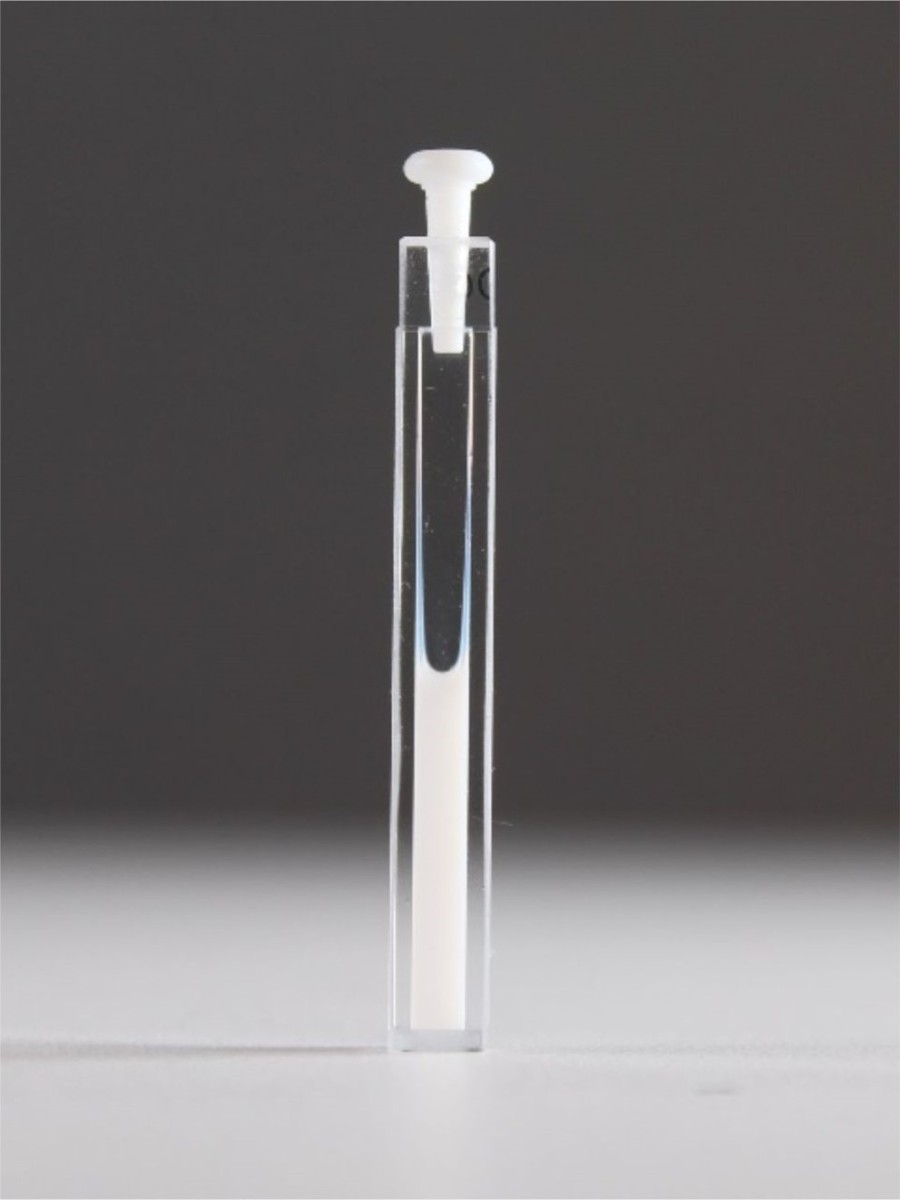
Understanding the impact of lipid nanoparticle size on immunogenicity represents an important step for enabling the rapid development of novel vaccines against known or emergent diseases.
Read in this application how the advanced DLS from LS Instruments enables the reliable measurement of particle size in a nanoemulsion at product concentration and high turbidity.
Featured instrument: NanoLab 3D
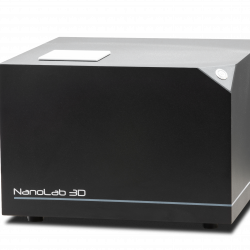
The NanoLab 3DTM is a benchtop DLS instrument equipped with the advanced DLS from LS Instruments. It enables the measurement of:
» Particle size & polydispersity
» Viscosity
Highest-quality optics coupled with the unique and patented multiple scattering filter technology enable the measurement of the widest range of samples.
Featured instrument: LS Spectrometer II

The LS SpectrometerTM II is a goniometer-based multi-angle light scattering instrument for comprehensive particle characterization:
» Particle size & polydispersity
» Particle shape
» Molecular weight
» Sample structure & particle interactions
» Viscosity
The instrument offers an unparalleled platform for light scattering experiments and, thanks to its modular design, a very versatile solution that can be optimized to meet specific customer requirements.